Thursday, February 10, 2011

Carrie Hunter, student profile

After years teaching chemistry and more years working as a trainer in the pharmaceutical industry, I left Ontario to pursue a PhD in EDST. I am interested in the intersection between The Knowledge Based Economy and Lifelong Learning. I am the GAA for CHET (Centre for Policy Studies in Higher Education and Training), a Research Assistant for the School of Medicine and I invigilate exams for Access and Diversity. I am active on the EDST Student Council, the PhD Management Committee and the Public Culture Committee, as coordinator of Wonderful Wednesdays’ Student Speaker Series. I have 2 teen sons, 2 cats and an unhealthy relationship with licorice candy. *grin*
I am posting a daily blog at LLLandtheKBA@blogspot.com in which I ruminate about readings I have been doing into Lifelong Learning and the Knowledge Based Economy. I encourage anyone interested in these issues to join me in dialogue there.

Thursday, February 3, 2011

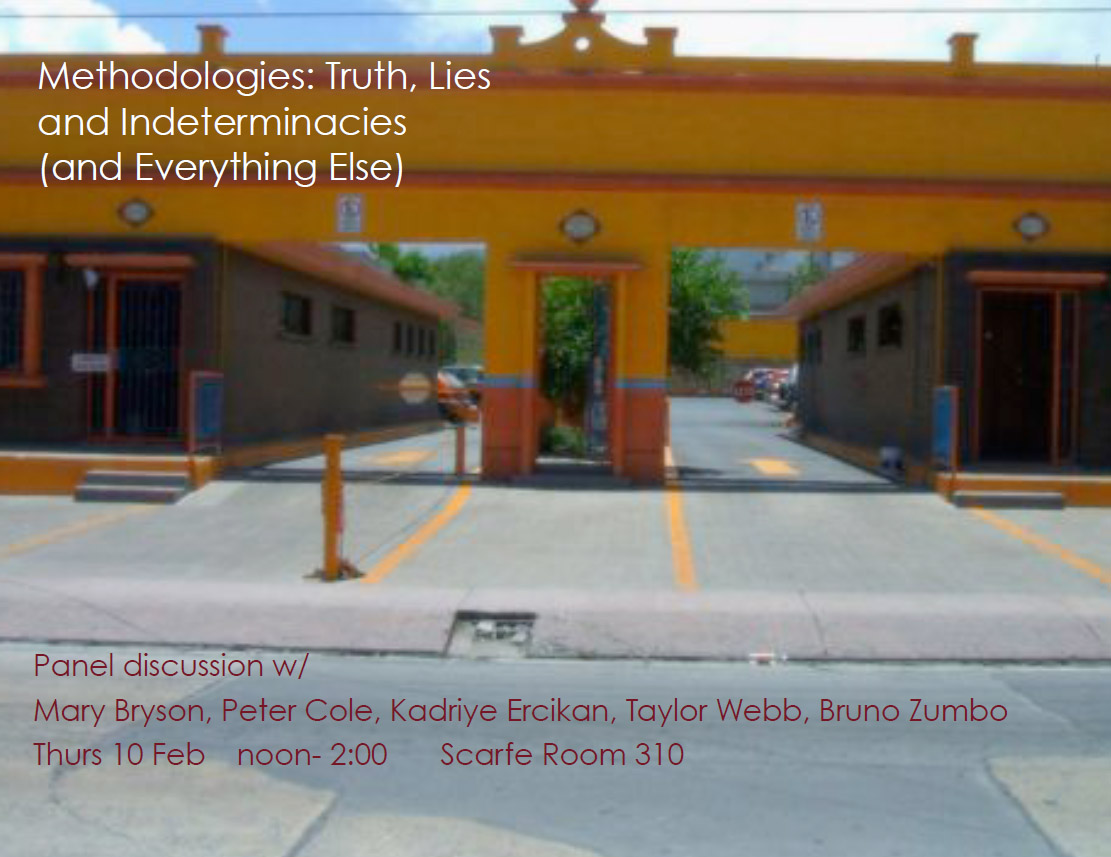
Methodologies: Truth, Lies and Indeterminacies (and Everything Else)

On February 10th, EDST faculty member Taylor Webb will participate on a panel discussion about methodologies, in UBC Faculty of Education’s Scarfe building, Room 310, from noon to 2:00pm. Please see the attached poster image for the complete list of panelists.

Wednesday, February 2, 2011

First Nations Education Policy in Canada: Progress or Gridlock? (2010)

2011 Public Culture Series presents a Book Launch. Feb 10, Professors Gerald Fallon, UBC & Jerry Paquette, University of Western Ontario: First Nations Education Policy in Canada: Progress or Gridlock? (2010). Toronto: University of Toronto Press.

Time: 4:30 pm, light refreshments provided. Location: EDST, 2044 Lower Mall, Ponderosa G, Lounge. Via Skype, meet Jerry Paquette and join the conversation in person with Prof. Gerald Fallon.

Abstract: How can First Nations schools in Canada offer quality education that is authentically and deeply Aboriginal yet meets the curriculum content requirements and standards of the provincial and territorial systems? This book addresses this question through and in-depth critical analysis of the major policy issues affecting First Nations education, with particular focus on developments that occurred since the mid-1980s. The authors challenge fundamental assumptions about Aboriginal education that have led to a balkanized and ineffective educational system, thus failing to meet the needs of its students. In response to this gridlock, the authors have formulated a conceptual framework that re-envisions the social, political, and educational goals of a self-governing First Nations educational system. Based on the underlying principles and vision within this framework, that author presents a series of recommendations for future policy changes. First Nations Education Policy in Canada lays the groundwork for a new conception not only in Aboriginal education but also of the future of Aboriginal self-determination.

See the EDST website for scheduling details and the lineup of future speakers.

Thursday, January 20, 2011

Gender and Higher Education in Times of Globalization

Dr. Nelly Stromquist
On March 10, 2011, as part of the Public Culture Series of Educational Studies, Dr. Nelly Stromquist of University of Maryland will give a talk, “Gender and Higher Education in Times of Globalization.” The typical US university encounters globalization primarily through competition with other universities for prestige and resources. These are the rewards they hope to gain by securing major funding for research, by emphasizing scientific and technological discoveries and marketable products, and by attaining top ranks in comparison with institutional peers at home and abroad. In this context, what types of knowledge are considered relevant? What spaces are left for critical thinking and voices? What specific challenges does gender face in research universities? My presentation will attempt to place challenges and possibilities in balance.

Dr. Stromquist holds a PhD degree in International Development Education from Stanford University and a master’s in political science from the Monterey Institute of International Studies. She specializes in issues related to social change and gender, which she examines from the perspective of critical sociology. Her research interests focus on the dynamics of educational policies and practices, gender relations, and equity, particularly in Latin America. She is author of numerous articles and several books. Among the books as sole author, most recent are Feminist Organizations and Social Transformation in Latin America (2006); Education in a Globalized World. The Connectivity of Economic Power, Technology, and Knowledge (2002); and Literacy for Citizenship: Gender and Grassroots Dynamics in Brazil (1997). She is also editor of La construcción del género en las políticas públicas. Perspectivas comparadas desde América Latina (2006); Distant Alliances. Promoting the Education of Girls and Women in Latin America (with Regina Cortina, 2000), Globalization and Culture: Integration and Contestation Across Cultures (with Karen Monkman, 2000). She was a Fulbright New Century Scholar during 2005–06 and is former president of the Comparative and International Education Society.
[Update]
A video recording of Dr. Stromquist’s talk is now available on the EDST website.

Wednesday, January 12, 2011

Todd May: Friendship as Resistance

Professor Todd May
On January 10th, as part of the Public Culture Series of Educational Studies, Professor Todd May of Clemson University, South Carolina gave a free lecture, “Friendship as Resistance: A struggle against consumerism and entrepreneurship in neoliberal times”.

Congratulations on a very successful genuinely public intellectual event, which generated a good deal of dialog and thought, bringing out students, faculty and most importantly, living up to what our Department is all about, opening space for discussion of matters crucial to education and social justice. I wish to commend Shayna Plaut and Jeannie Kerr for their thoughtful provocations of Todd May’s talk. I also thank Dr. Claudia Ruitenberg for her tireless efforts to bring Todd here. Thanks as well go to Kjell Rubenson, Nora Timmerman & Carrie Hunter, and Roweena Bacchus of the Public Culture Committee, The Democracy Cluster, Policy Studies Cluster, & SCPE and Don for hosting the wine & cheese. I counted some 45 in our audience from across the campus.

Please provide feedback to the Public Culture Committee about this event, its format and ways to increase our dialog and community. Also, see the Jan.–March 2011 lineup of speakers in the Series on our website announcing future talks in the Public Culture Series.

Professor Leslie G. Roman, Chair, Public Culture Committee

Monday, January 10, 2011

Nadine Fabbi, Student Profile

Nadine C. Fabbi is currently enrolled in the EdD program in EDST as part of the 2009 Cohort, and works as the Associate Director of the Canadian Studies Center at the University of Washington in Seattle. For her doctorate she is researching Canadian Inuit political mobilization in the Arctic region—both geopolitical self-determination and emerging strategies in educational policy. In 2010 she was awarded a Graduate Research Fellowship from University of the Arctic and the Government of Canada for her proposal, “Arctic Educational Policies and their Impact on Canada’s Leadership Role in the Circumpolar World.” In 2007 Nadine utilized a Government of Canada Faculty Research Grant, “Inuit Homelands in Canada” to design the first Task Force on the Arctic. In 2009 she was awarded a Program Enhancement Grant to take 13 University of Washington students to Ottawa as part of the first Task Force on Arctic Sovereignty co-taught with Professor Gallucci. Nadine has travelled to Alaska, the Yukon, Greenland, Iceland and Siberia and has taught two summer programs on Inuit homelands for the University of Alberta. In 2008 she was awarded a Certificate of Merit by the International Council for Canadian Studies in recognition of her contributions to Canadian Studies. Read more about Nadine and her work at the Canadian Studies Center: http://staff.washington.edu/nfabbi/index.shtml.

Wednesday, January 5, 2011

ALGC Students on Campus

In July 2008, several members of the 2006 Cohort of the Adult Learning for Global Change (ALGC) program had the opportunity to meet face to face. The occasion was a course on Lifelong Learning, taught by Dr. Kjell Rubenson on the UBC Vancouver campus. The seminar gave us an opportunity to connect on a more personal level with the program, the participants, and the university. We also had a chance to hear presentations by researchers in addition to Dr. Rubenson such as Dr. Tara Fenwick (now at the University of Stirling, UK) and Dr. Garnet Grosjean (UBC) on current learning projects at both local (provincial) and international scales. Pictured in the photograph, L. to R: Jackie Regan (Windsor, ON), Rowena delRosario (Edmonton, Alberta), Vivian Hermansen (Campbell River, BC) and Fereshteh Dastani (Shanghai, China). The ALGC program was an important rung in our lifelong learning “ladder”—and these interpersonal connections will never disappear.